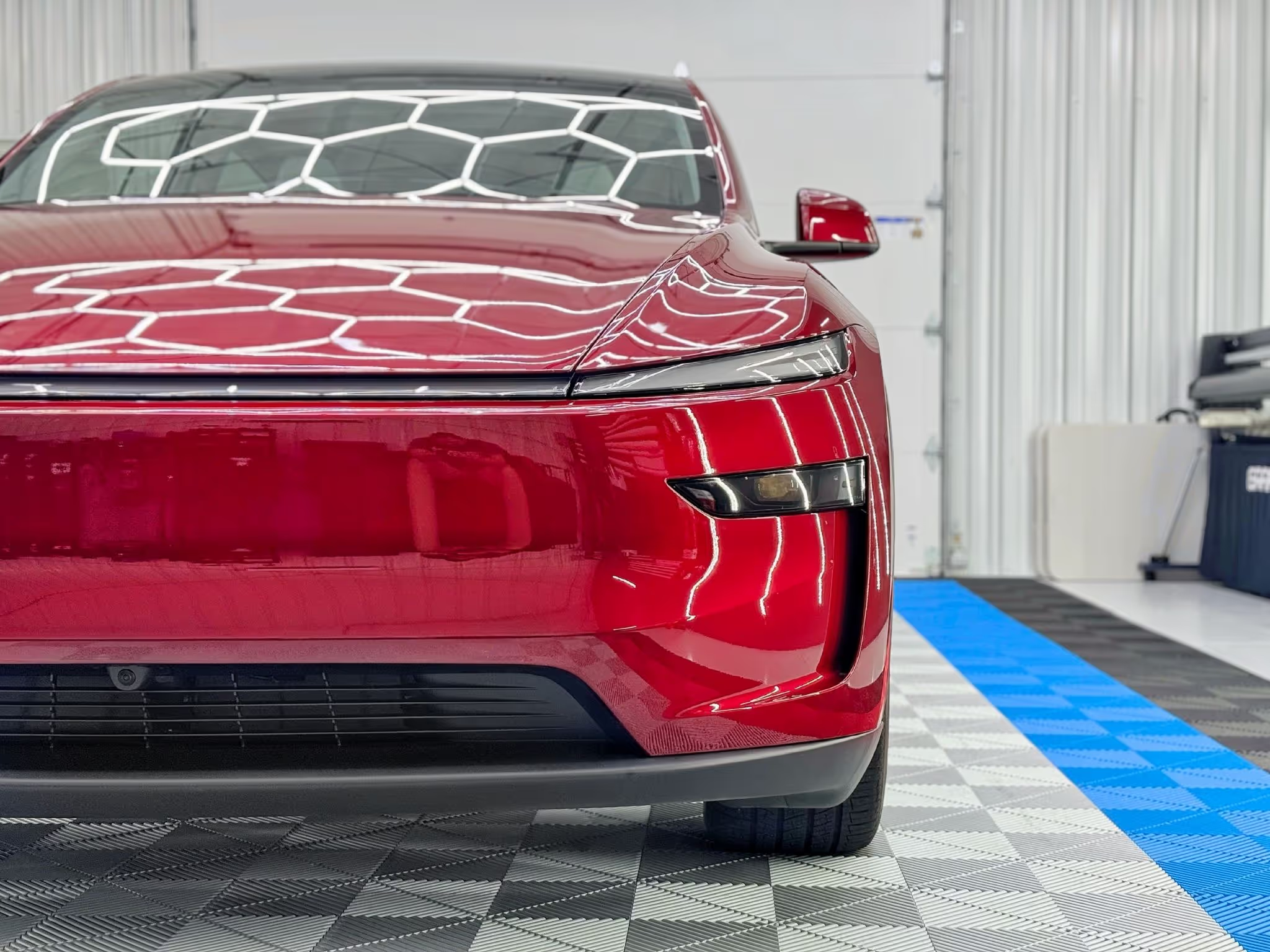
Tennessee and Georgia set different window tint standards, which matters if you cross the line daily from Ringgold, Fort Oglethorpe, or Rossville. Here is where the rules diverge and how to install for both.


.png.webp)


.png)
Chattanooga sits close enough to the Georgia line that plenty of drivers cross it every day. Ringgold, Fort Oglethorpe, and Rossville commuters are in Tennessee by breakfast.
The two states have different tint standards. Here is what each requires, where they diverge, and how to handle a vehicle that lives on both sides of the line.
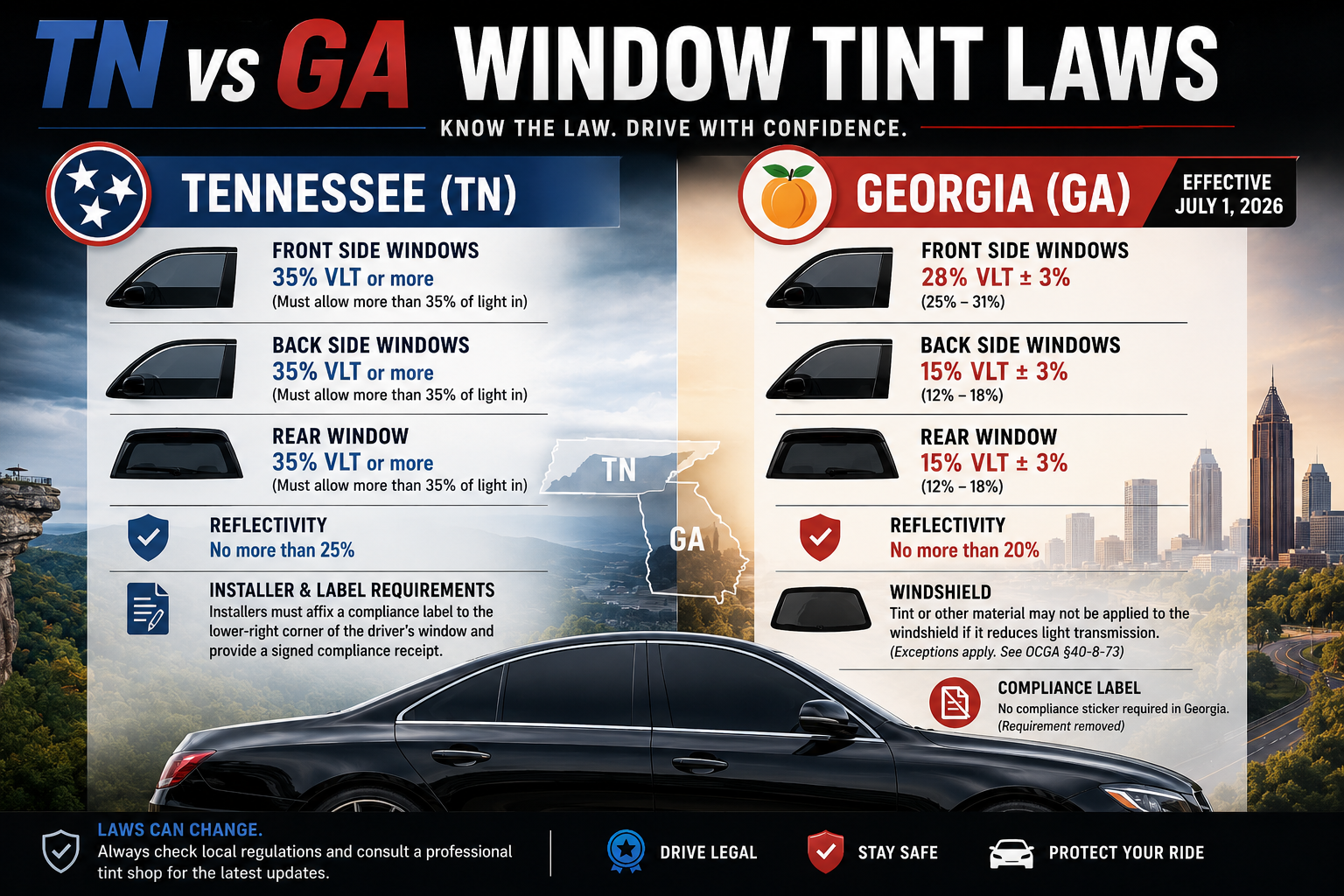
Both states regulate using VLT — visible light transmission — which is the percentage of light that passes through the glass. Higher VLT means lighter tint. A 35 percent VLT film allows 35 percent of light through.
The critical detail people miss: enforcement measures film plus factory glass together. Nearly all automotive glass blocks some light on its own, and many SUVs and trucks come with substantially darker privacy glass in the rear from the factory.
So a film sold as 35 percent does not produce a 35 percent reading once installed. It produces something lower, because the glass underneath is contributing. This is why metering the actual vehicle matters more than the number on the film box.
Front side windows must allow at least 35 percent VLT. Rear side windows and the rear windshield may be darker. Windshields permit non-reflective film above the AS-1 line.
Reflective and mirrored films are not permitted.
Georgia sets its own limits, and while the front-window standard is in a similar range, the specifics around rear windows, reflectivity, and required equipment differ from Tennessee's.
We keep current on both because a meaningful share of our customers drive across the line regularly, and the details change often enough that it is worth confirming rather than assuming.
Your vehicle is governed by the law of the state where it is registered. But you can be cited in another state for violating that state's rules while driving there.
In practice, enforcement tends to follow the officer's own state standard. A Georgia-registered car pulled over in Chattanooga is being evaluated against what that officer knows and measures.
The practical implication for anyone commuting across the line: install to the stricter standard. It removes the ambiguity, and it costs nothing extra to choose a legal shade over a marginally darker one.
Both states allow darker tint for documented medical conditions involving light sensitivity, and both require paperwork from a licensed provider.
Two things worth knowing. The processes are not identical, and an exemption in one state does not automatically carry to the other. And exemptions cover the person, not the vehicle — documentation needs to be in the car.
If you have a legitimate medical need, we will help you choose appropriate film and make sure you understand what documentation to carry. What we will not do is treat an exemption as a workaround for wanting darker windows.
Some drivers want more privacy or heat control than either state permits. That is a choice you are entitled to make, and we will install it — after you sign a waiver acknowledging you understand the risk.
What we will not do is install darker film and let you believe it is legal. You get the meter reading, you get told exactly where it lands relative to both states, and then you decide.
Being direct about the risk: a citation for illegal tint typically means a fine plus a requirement to remove the film, which means paying twice — once to install, once to remove, and again if you want compliant film afterward.
Here is the part that resolves most of these conversations.
Darkness and heat rejection are separate properties. Ceramic film blocks up to 96 percent of infrared heat regardless of how dark it is, because heat rejection comes from the film technology rather than the shade.
A legal 35 percent ceramic film keeps a cabin cooler than an illegal 20 percent carbon film. If your actual goal is comfort rather than appearance, the legal option performs better — which makes the whole legality question moot.
Most people who come in wanting to push the limit are surprised by this, and most of them end up choosing legal ceramic once they understand it.
If you cross the state line regularly, the practical answer is to install to the stricter of the two standards, which for front side windows means Tennessee's 35 percent.
We meter every vehicle before it leaves and tell you exactly where you stand in both states.
Answers to the burning questions in your mind.

Your vehicle is governed by the law of the state it is registered in, but you can still be cited in another state for violating that state's standards while driving there.
In practice, officers most often enforce against their own state's rules. If you live in Georgia and commute into Tennessee daily, installing to Tennessee's front-window standard removes the question entirely.
Both states allow medical exemptions with proper documentation, but the processes and paperwork differ. Georgia requires an affidavit from a licensed physician or optometrist. Tennessee has its own documentation requirements.
An exemption granted in one state does not automatically transfer to the other. If you split time across the line, carry documentation and understand that enforcement is at the officer's discretion.
A meter reads the total light coming through — film plus whatever the glass itself blocks. Most vehicles have some factory tint in the glass, and SUVs and trucks often have substantially darker privacy glass in the rear.
That is why the same film produces different readings on different vehicles, and why a shop that meters your specific glass before installing is giving you a more useful answer than one quoting film percentages alone.
.avif)