Matte finishes cannot be polished, which means defects cannot be corrected — only prevented. Here is why standard gloss film ruins a matte finish, what matte-specific film does, and how care differs.





Matte and satin finishes have one characteristic that changes every protection decision: they cannot be corrected. There is no polishing out a defect, because polishing is exactly what destroys the finish.
That makes film a different proposition on matte than on gloss. Here is what matte paint protection film is, why the standard version will ruin your finish, and how care differs.
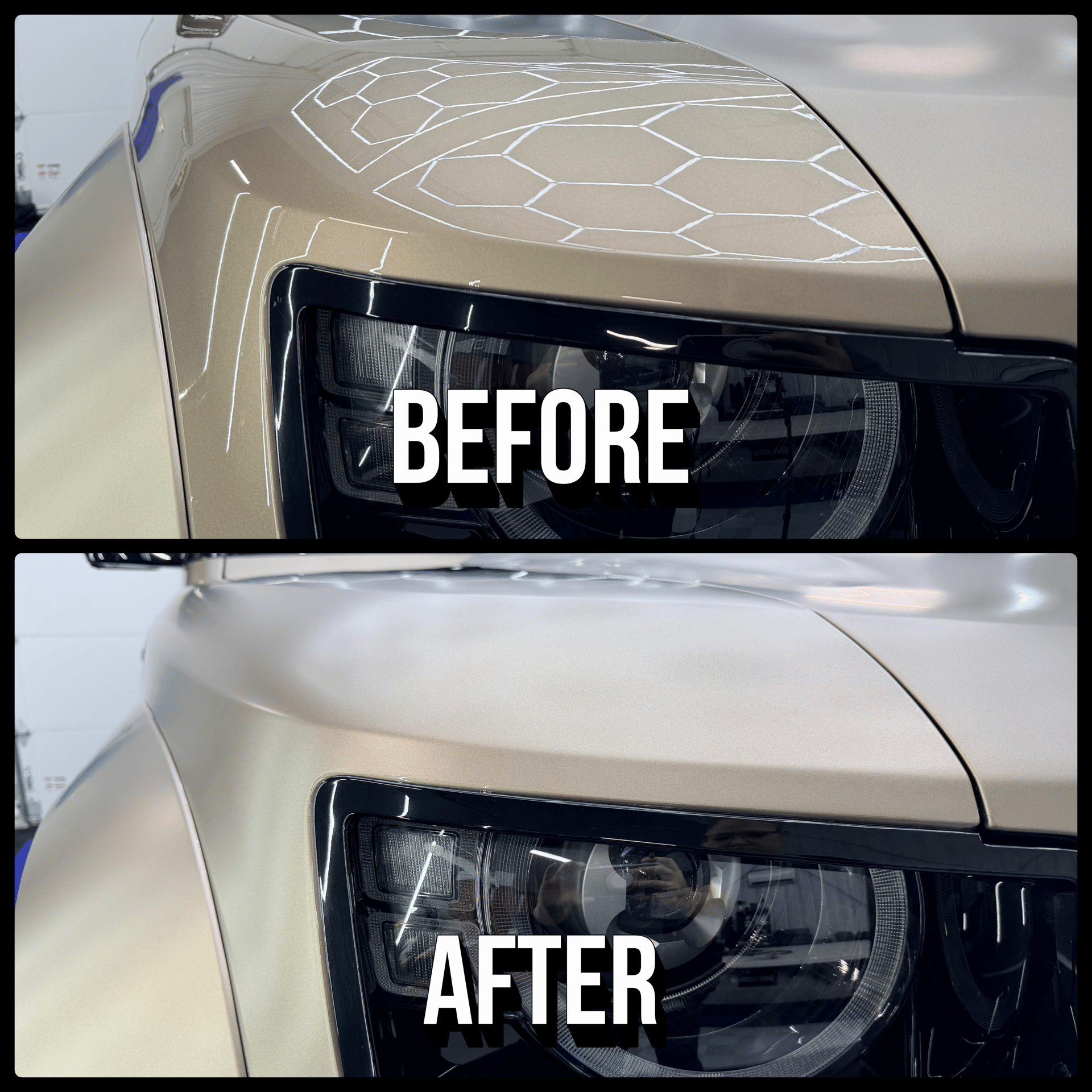
A gloss finish is smooth at a microscopic level. Light hits it and reflects back uniformly, producing shine and depth.
A matte finish has a deliberately textured clear coat. That texture scatters light in every direction instead of reflecting it, and the diffusion is what creates the flat appearance.
The texture is the finish. Anything that flattens or fills it converts that area to gloss, permanently. Which means matte cannot be polished, cannot be corrected, and cannot be waxed.
On a gloss car, a rock chip is expensive but fixable. On matte, the panel gets refinished with matte clear or wrapped — there is no middle option. That asymmetry is the entire argument for film on a matte vehicle.
This is the mistake that costs people their finish.
Conventional paint protection film has a gloss top layer. Applied over matte paint, it converts the finish to gloss everywhere the film sits. You end up with a car that is glossy on the hood and fenders and matte everywhere else, and the only fix is removing the film.
Matte paint protection film exists specifically for this. It has a textured top layer that scatters light the same way matte clear coat does, so the finish underneath stays visually unchanged. It still self-heals, still absorbs impact, still carries a full warranty.
If a shop quotes you film for a matte vehicle without asking what finish you have or mentioning matte-specific product, that is a signal worth paying attention to.
Matte is not one thing. There is a range from satin to full flat, and factory finishes vary meaningfully between manufacturers.
Matte film also comes in different levels of matte. Getting the film to visually match the surrounding unfilmed panels requires selecting the right product for that specific vehicle, and it is not always obvious from a sample card.
This is why matte installs benefit from a test area or a careful visual comparison before committing to full coverage. A slight mismatch shows most in direct sunlight at an angle — exactly the condition where matte finishes look their best and their differences show most.
Full coverage sidesteps the matching problem entirely, since every painted panel gets the same film. That is one reason full vehicle coverage is more common on matte cars than on gloss.
Matte film follows matte paint rules, which are the opposite of conventional car care.
Hand wash only, with pH-neutral soap labeled matte safe. Standard car soaps frequently contain gloss enhancers.
No wax, no polish, no standard ceramic coating. All three add gloss to a surface designed not to have any.
No automatic washes. Brushes abrade the texture and the wax-based sealants many of them apply cause the exact problem you are avoiding.
Blot dry rather than dragging a towel. Dragging can burnish the texture smooth.
Remove contamination promptly. Bird droppings and sap are more consequential on matte because the etching cannot be polished out afterward.
Matte ceramic coating exists and it works over matte film the same way it works over matte paint. It bonds and provides UV resistance, chemical resistance, and hydrophobic properties without filling the texture.
On matte, this is a stronger argument than on gloss. Coating a gloss car is convenience and protection. Coating a matte car is protection with no fallback, because if contamination does etch the surface there is no correction available.
What to avoid, again: standard ceramic coating. Conventional formulations are designed to add depth and gloss. On matte they create uneven sheen you cannot undo.
Worth distinguishing, because people use the terms interchangeably and the products differ.
Factory matte paint is textured clear coat over the color. Permanent, expensive to repair, cannot be polished.
Matte vinyl wrap is film applied over conventional gloss paint to change the appearance. It has its own care requirements, but it is replaceable panel by panel, and the paint underneath is intact.
Matte paint protection film is protective film with a matte top layer. It can go over matte paint to protect it, or over gloss paint to change the look while adding protection.
That last option is worth knowing about. If you want a matte appearance but do not want to commit to matte paint, matte film gives you the look plus impact protection, and it removes cleanly.
Being direct: if a matte panel has a shiny spot from wax, polish, or a wash brush, film will not hide it. Film is transparent and the gloss underneath shows through.
The options are refinishing that panel with matte clear or covering it with matte wrap. Neither is cheap, which is why prevention is the whole strategy with matte finishes.
Matte finishes cannot be corrected. That single fact makes protection the entire strategy rather than one option among several.
Matte paint protection film gives you a sacrificial layer over a finish that otherwise has no defense, and it comes off cleanly if you ever want the factory surface back.
Answers to the burning questions in your mind.

No, and this matters more than most people realize. Gloss film over a matte finish converts it to gloss — you lose the entire look you paid for.
Matte film has a textured top layer that scatters light the same way matte clear coat does. It is a different product, and it has to be specified deliberately.
Yes, and it works the same way — heat causes light scratches in the film to disappear. What differs is what happens underneath if the film is compromised.
On gloss paint, damage that reaches the surface can often be corrected. On matte, it cannot. That asymmetry is why film is a stronger argument on matte than on conventional paint.
You can apply matte film over gloss paint, and some people do specifically to change the appearance. It is a reversible way to get a matte look without repainting.
What you cannot do is apply gloss film over matte paint and expect the matte to survive. That converts the finish permanently as long as the film is on.